

By Divya Munjal
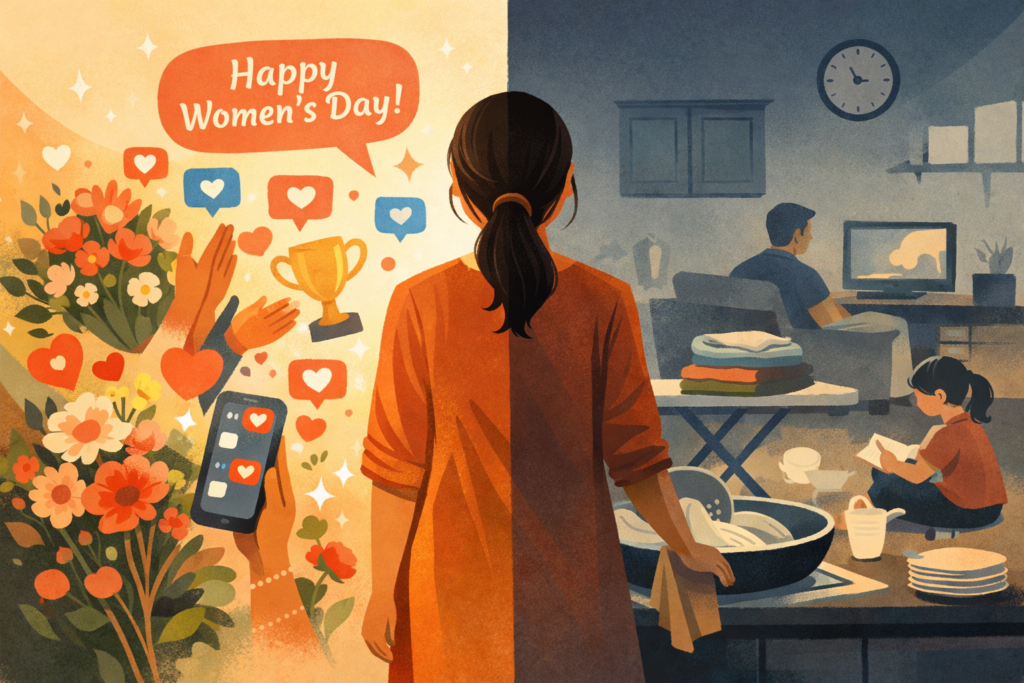
At 9 am she receives a message:
“You are strong. You are inspiring. Happy Women’s Day.”
At 9 pm she is still in the kitchen, clearing plates while everyone else relaxes.
This is not anger. It is observation. I know many women will recognise it instantly.
Every year, March 8 arrives with praise, flowers and carefully written posts. By March 9 life continues exactly as before. The question that stays with me is simple: What is the purpose of celebrating Women’s Day if we cannot respect women in our own homes?
Where it all began
International Women’s Day began in the early 1900s when women worldwide were fighting for basic rights like voting, fair wages and safe working conditions. It was not designed as a celebration. It was a demand. A protest. A call for equality.
Over the decades, it grew into a global movement. Countries across the world now mark March 8 as a day to recognise women’s achievements in politics, education, business and science.
The intention was powerful: dignity and equal rights.
What it looks like today
Today, the tone often feels different.
Social media fills with quotes about women’s strength. Offices distribute roses and chocolates to women employees. Brands announce Women’s Day sales. Panels discuss empowerment for an hour and move on.
There is nothing wrong with appreciation. Recognition matters. But sometimes it feels like performance more than progress.
A friend once told me how her company organised a grand Women’s Day event. There were speeches about leadership and breaking barriers. Cupcakes were distributed. Photographs were taken. The next week she was told she could not take up a bigger project because it would require late hours and “family responsibilities should come first”.
The applause was loud. The opportunity was silent.
In another instance, a woman received a beautiful saree as a Women’s Day gift. The same evening, she was reminded that managing the household was “naturally her role”. The gift felt generous. The expectation felt permanent.
It is fair to pause and ask: Has this day quietly become a business opportunity for brands?
The everyday reality at home
Respect is not measured in bouquets. It is measured in behaviour.
It is in the daily, small moments.
A young woman I know wanted to pursue a course in another city. Her family celebrated her academic achievements proudly on social media. However, when she expressed her wish to move out, the response was, “Why do you need to go so far? We will find something suitable here.”
Another woman manages a full-time job. She attends meetings all day, meets deadlines and handles pressure. In the evening, she rushes home, supervises homework, prepares dinner and ensures everything runs smoothly. When she feels exhausted and asks for help, she is told, “You are so good at handling everything.”
What sounds like praise is often expectation.
There are countless such stories. They do not make headlines. They do not trend on internet. However, they shape our daily lives.
Planning family events.
Remembering medical appointments.
Managing school schedules.
Caring for elders.
Keeping peace during disagreements.
All these responsibilities remain invisible until they are not done.
The uncomfortable truth
What unsettles me even more is this: Sometimes, we are satisfied with that one day.
We dress up. We post pictures. We thank people for their wishes. We celebrate “womanhood” with pride.
And then, we return to routines that do not treat us as equals.
It is easier to celebrate for a day than to question patterns that have existed for years. The celebration can become comfortable. It gives us recognition without requiring change.
This is not about blaming men or women. Many of us have been taught to adjust, to compromise, to be grateful for small gestures. We are told not to create conflict. We are taught that this is how things are.
However, we must ask ourselves honestly: Are we accepting appreciation in place of equality?
What real respect looks like
Real respect is consistent.
It looks like shared household work without reminders.
It looks like listening without interrupting.
It looks like encouraging daughters and sons equally.
It looks like supporting ambition without attaching guilt.
It looks like equal say in decisions that shape the family.
Respect is daily practice, not annual applause.
So what is the purpose?
International Women’s Day still has meaning. Its history reminds us of courage and collective strength. However, its relevance depends on what we do beyond March 8.
If it remains a day of flowers and filtered posts, it changes little.
If it becomes a reminder to examine our homes, workplaces and attitudes, it can still matter.
Women do not need to be celebrated for a day. They need to be respected every day.
The applause will fade. The posts will disappear.
What remains is how we treat women when no one is watching.
Wow Divya. Loved it🧡
Thank you, Payal. Glad to know that you loved this article.