

By Divya Munjal
Have you ever stood in front of a buffet, plate in hand, promising yourself you will eat “just a little” and then quietly going back for seconds… as that promise slips away?
If that sounds familiar, you are not alone. Social gatherings test even the most disciplined fitness routines. The food looks inviting, the mood is relaxed and suddenly all those well-planned meals feel far away.
I am currently on a structured fitness program where my diet and exercise are planned by a nutritionist. During one of our discussions, I asked her a simple question. What should I do when I have to attend a function?
Her response sounded simple. Almost too simple. But when I followed it, I realised how thoughtfully it was designed.
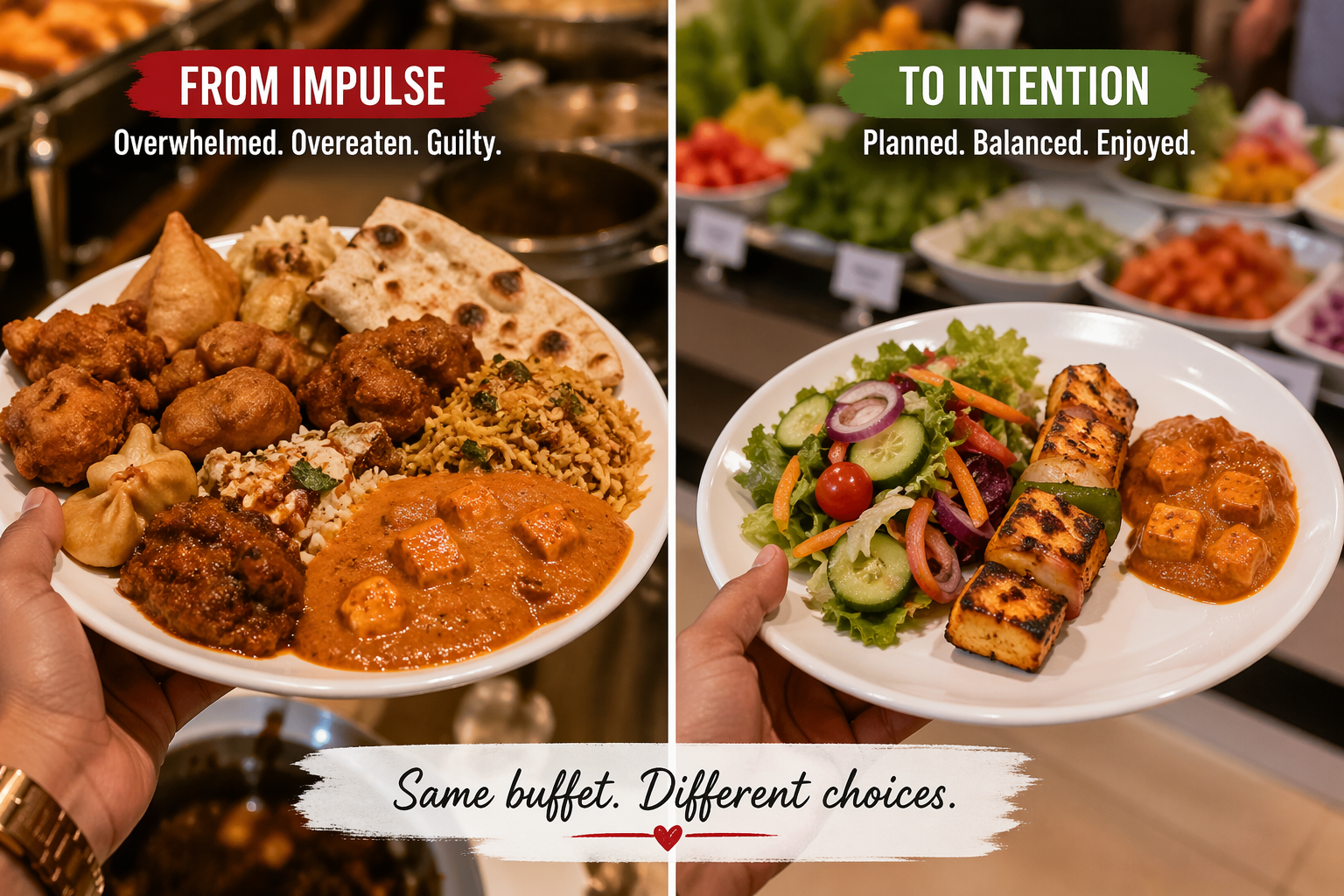
My nutritionist said, “Do not go hungry. Eat at least half your dinner at home. Drink water. Start with salad. Then have tikkas. And only if you are still hungry, take a small portion of your favourite dish.”
It felt structured, almost like a sequence. And that is exactly what it is.
The mistake I used to make
Earlier, I would try to “save calories” for the event. I would eat very little during the day, thinking I was being smart. But by the time I reached the venue, I would be starving. And when you are that hungry, logic does not stand a chance against a plate of hot starters.
What changed this time
The last time I had a family function to attend, I decided to follow this advice properly.
Before leaving home, I ate about half of my usual dinner. Not a full meal, but enough to take the edge off my hunger. I remember thinking, “Was I going to miss out on the food at the function?”
But something interesting happened. When I reached there, I was not desperate to eat. I could actually look at the food calmly.
That is the first shift.
Why not going hungry changes everything
When you are not hungry, you are not reactive.
You are not grabbing the first thing you see. You are not piling your plate out of urgency. Your decisions slow down. You become more aware of what you actually want to eat.
This one step changes the entire experience of being at a buffet.
The simple power of starting with water
I started with a glass of water. It sounds basic, but it works.
Often, we confuse thirst with hunger. Drinking water also creates a slight sense of fullness. It slows you down and gives you a pause before you start eating.
Why salad comes next
Then came the salad.
It is not the most exciting part of a function, but I treated it as a step, not the main event. I took a decent portion, ate it slowly and let my body catch up.
Salads are high in fibre and volume. They fill you up without adding too many calories and prepare your system for what comes next.
The logic behind starting with tikkas
After that, I moved to the tikkas.
This was the part I was actually looking forward to. Paneer tikka, in my case. Grilled, flavourful and satisfying.
What I had not realised earlier is how powerful protein is in controlling hunger. A few pieces in, I already felt quite full. Not heavy, just comfortably satisfied.
Because tikkas are eaten piece by piece, they naturally slow you down. You are not rushing through your meal. You are giving your body time to signal that it has had enough.
Choosing your favourite dish, but differently
By the time I finished this sequence, something surprising happened. I was no longer eyeing everything on the buffet.
Earlier, I would think, “I want to try this and this and this.” This time, I paused and asked myself, “What do I actually feel like eating?”
That is when the last part of my nutritionist’s advice came in.
“If you are still hungry, take a small portion of your favourite dish.”
Not everything. Not a little of all options. Just your favourite.
For me, it was a particular gravy dish I really enjoy. I took a small portion and because I was not starving, I could truly enjoy it. The taste, the texture, the experience. I did not feel the need to go back for more.
What this approach really does
This approach works on multiple levels.
First, it manages your physical hunger. By eating before you leave and starting with water, salad and protein, you are not letting your hunger spike.
Second, it changes your behaviour. You are no longer reacting to food. You are choosing it.
Third, it protects you from the high-calorie traps that are common at functions. Fried starters, rich gravies, breads and desserts can quickly add up. When you are already somewhat full, you naturally eat less without feeling deprived.
Why it feels sustainable
Perhaps the most important part, it takes away the feeling of restriction.
You are not telling yourself that you cannot eat anything. You are simply changing the order in which you eat. You are creating a buffer between your hunger and the indulgent food.
This makes the whole process sustainable.
Because social events are a part of life. Avoiding them is not realistic. But losing control at every event does not feel good either.
A small shift that makes a big difference
It is also interesting how much of this is psychological.
When you know you will still get to eat your favourite dish, just in a smaller portion, the urge to overeat reduces. There is no panic. No feeling of missing out.
Over time, this becomes a habit. You stop overthinking. You do not need to calculate calories in your head at every event.
You simply follow the sequence.
“Eat a little at home. Drink water. Start with salad. Add protein. Then choose one thing you really want.”
It is simple, but not simplistic.
The next time you have a function to attend, try this approach. Not as a rule you must follow perfectly, but as a framework you can rely on.
You still enjoy the food. You still feel part of the celebration. And this time, you leave feeling in control rather than wondering where things slipped.