

By Divya Jyoti Munjal
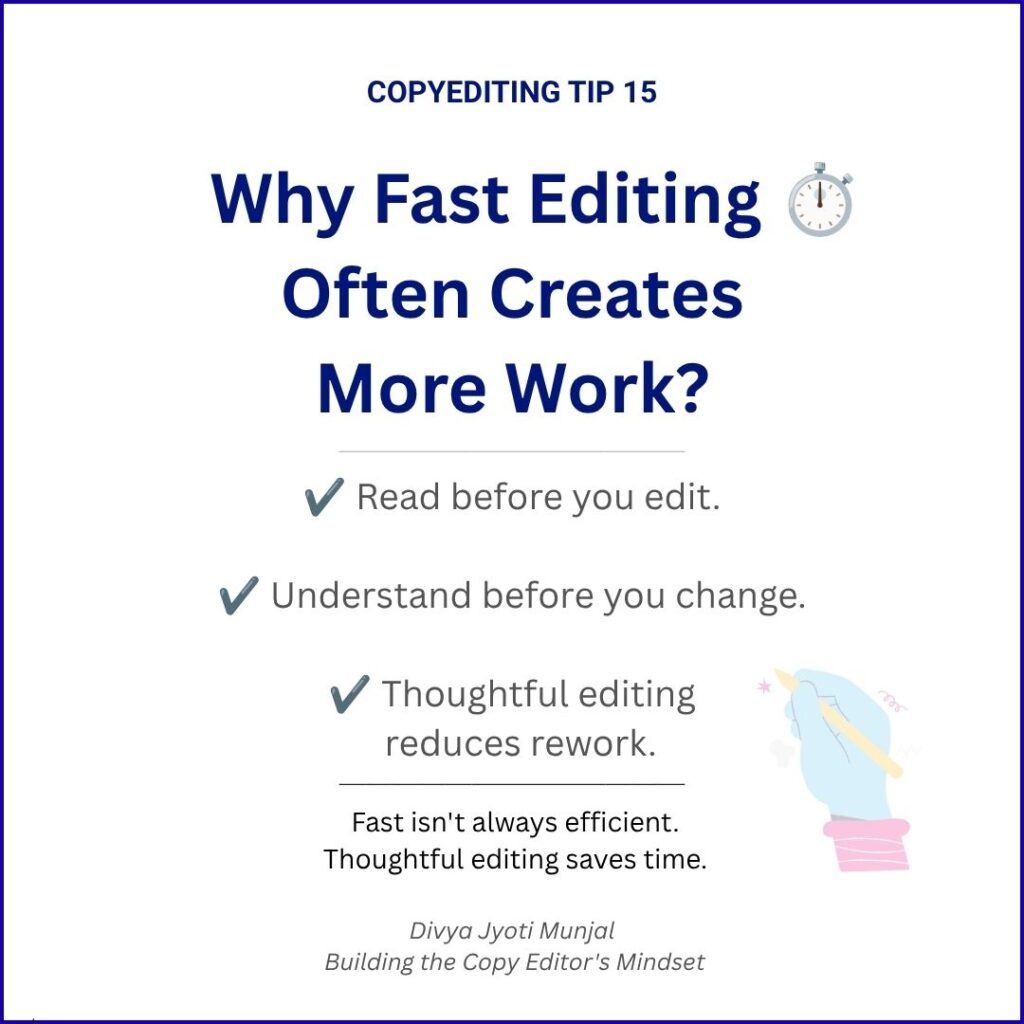
Speed is often seen as a sign of efficiency. In copyediting, however, speed without careful judgment can become expensive. An editor may finish a manuscript more quickly, but if important issues are overlooked or unnecessary changes are introduced, the time saved during editing is often lost during later stages of the project.
A manuscript that requires extensive rework is rarely the result of working too slowly. More often, it is the result of moving through the text before fully understanding it.
A representative example
Imagine a copy editor who sets a personal target of editing 50 pages in a single day.
Determined to meet that goal, the editor moves quickly through the manuscript, correcting grammar, rewriting sentences, adjusting punctuation, and changing wording wherever an alternative seems possible.
By the end of the day, the editor successfully meets the target and sends the edited chapters to the author for review.
Instead of a straightforward approval, the author returns numerous comments.
Some edits have changed the intended meaning. Others have altered the tone of the writing. Certain technical terms have been replaced unnecessarily, and several revisions have introduced inconsistencies between chapters because the editor focused on individual pages rather than the manuscript as a whole.
The project soon begins to slow down. The author raises numerous questions about the edits, explains that several changes have altered the intended meaning, and requests revisions. The copy editor has to revisit the manuscript, reverse some edits, clarify others, and make additional changes before the chapters can move forward. What initially appeared to be a fast edit has now created extra work for both the author and the editor.
What appeared to be a productive day’s work has now created another round of editing for everyone involved.
The manuscript eventually reaches the desired quality, but only after considerably more effort than would have been needed if the editor had taken a more thoughtful approach from the beginning.
What went wrong?
The problem was not the editor’s knowledge.
The problem was allowing a page target to become more important than editorial judgment.
Professional copyediting is not measured by the number of pages completed in a day. It is measured by the quality of the editorial decisions made while working on those pages.
An editor who takes time to understand the manuscript, recognize patterns, and think through difficult decisions is often more efficient than an editor who works quickly but creates unnecessary rework.
The real measure of efficiency
Efficiency in copyediting is not about finishing first.
It is about completing the work well enough that it moves smoothly through author review and the rest of the publishing process without avoidable revisions.
Sometimes slowing down during the first edit is the fastest way to finish the project.
That is one of the reasons I emphasize editorial judgment throughout Building the Copy Editor’s Mindset. Good copyediting is not simply about correcting text. It is about making decisions that strengthen the manuscript while avoiding unnecessary work for everyone involved.