

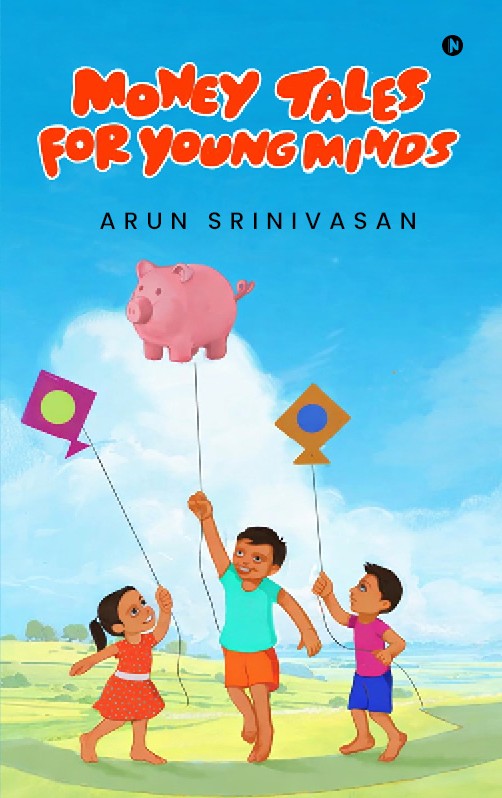
Money Tales for Young Minds
Arun Srinivasan
Please introduce yourself to our readers.
I am Arun Srinivasan, a certified editor from Chennai who loves turning complex ideas into simple, engaging stories. If there is one thing I never seem to outgrow, it is asking “Why?” That little question has taken me from editing scientific manuscripts to writing stories for children, and I am still just as curious today as I was growing up. When I am not writing or editing, you will probably find me travelling, planning my next adventure, reading, or chatting with curious young minds who ask the most unexpected, and often the best, questions. I believe learning should be enjoyable, conversations should spark curiosity, and every good story should leave you thinking long after you have finished reading it. That belief inspired me to write Money Tales for Young Minds, where everyday stories make money concepts simple, relatable, and fun for children.
What inspired you to write this book?
The idea for this book began with a question from my niece. One day, she asked me to explain inflation and the stock market. A few of her friends joined the conversation, and what started as a casual chat turned into an impromptu learning session. Instead of definitions and jargon, I found myself using everyday analogies and simple stories to explain these concepts. To my surprise, they were completely engaged. They asked more questions, challenged my examples, and genuinely enjoyed the discussion. That day made me realize that children do not find money boring; they just need someone to explain it in a language they understand. Money Tales for Young Minds grew from that realization.
Please tell us about your book. What is it about, and who is it written for?
Money Tales for Young Minds is a collection of short stories that introduces children to important money concepts through everyday adventures and relatable characters. Rather than teaching through definitions or complicated financial jargon, the book uses simple stories, analogies, and real-life situations to make ideas such as loans, inflation, the stock market, and smart decision-making easy to understand. It is written primarily for children, but I have found that parents, teachers, and even adults enjoy reading it with them. My hope is that the stories spark conversations at home and help children build confidence in talking about money from an early age.
What was the most enjoyable or the most challenging part of writing this book?
The most enjoyable part was creating stories that entertained while quietly teaching an important lesson. It was satisfying to watch everyday situations transform into meaningful learning experiences. The biggest challenge was maintaining the right balance. I did not want the book to sound preachy or like a textbook. Children quickly lose interest if they feel they are being lectured. I spent a great deal of time refining the stories so that the lessons emerged naturally through the characters’ actions rather than being explicitly explained.
What do you hope readers will take away after reading your book?
More than anything, I hope the book makes children curious. I would be delighted if they finish reading a story and start asking healthy questions about money to their parents, teachers, or other adults in their lives. Questions are where real learning begins. If the book encourages conversations about saving, spending, borrowing, investing, or making thoughtful financial choices, then it has achieved its purpose. I do not expect children to become financial experts overnight. I simply hope they become more confident, more curious, and more comfortable talking about money from an early age.
Where can readers purchase your book? Please share the link.
Kindle: https://amzn.in/d/0i2dVMGw
Paperback: https://amzn.in/d/0cyFUuCu
Hard cover: https://amzn.in/d/0bwKXtfp
I am excited to explore through the pages.