

By Divya Jyoti Munjal
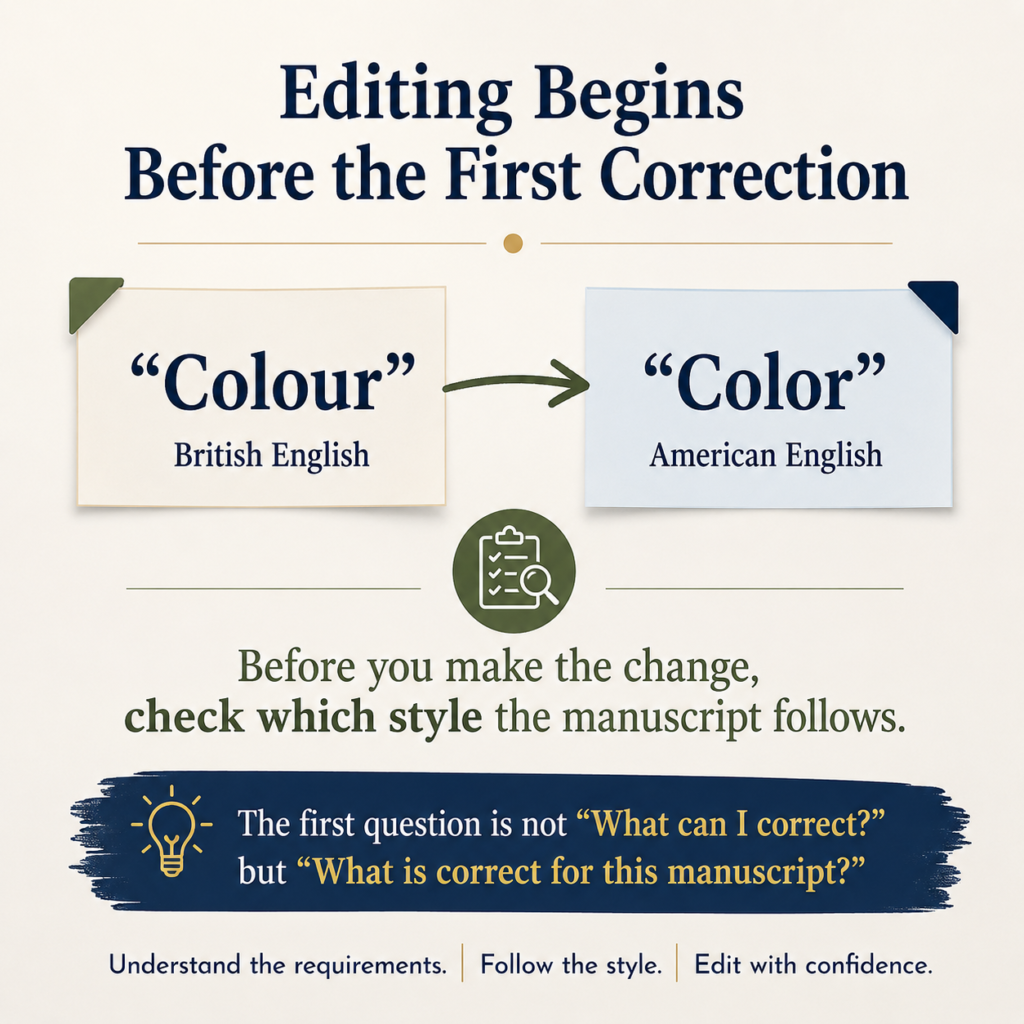
When a copy editor receives a manuscript, it can be tempting to begin with the first sentence, notice the first error, and make the first correction.
However, the editing process needs to begin before any changes are made to the text. The editor first needs to understand the manuscript, the level of editing expected, the style to be followed, and any instructions specific to the journal, publisher, or project.
These details influence many of the decisions that follow. Starting with corrections without understanding the project requirements can lead to unnecessary changes and repeated work later.
Start with the instructions
Imagine receiving an article in which the word “organization” is spelled with a “z.” An editor accustomed to UK English may immediately change it to “organisation.”
However, a quick look at the journal instructions shows that the journal follows US English. The change was unnecessary and could have been avoided by checking the instructions first.
The same can happen with capitalization, punctuation, abbreviations, references, headings, numbers, and other elements. Reading the instructions and style sheet before editing establishes the framework within which decisions should be made.
Look at the manuscript as a whole
Once the instructions are clear, take a quick look through the manuscript.
Notice the headings and subheadings, tables, figures, lists, references, footnotes, and other elements. You may already begin to see patterns or inconsistencies.
For example, one heading may appear as “Results and Discussion,” while another follows a different capitalization style. A technical term may appear in two forms, or abbreviations may not be introduced consistently.
There is no need to correct everything during this initial review. The purpose is to understand the manuscript and identify areas that may require particular attention.
The first few pages can also tell you something about the author’s writing. Does the author use long sentences? Are certain errors recurring? Is there a particular terminology or writing style that needs to be retained?
Understanding these patterns can help you distinguish an error from an intentional choice.
Do not rush into global changes
The initial review may reveal something that appears easy to correct throughout the manuscript. Before using “Find and Replace,” check how the term or construction is being used in different places.
A global replacement that works correctly in nine instances may create an error in the tenth.
“Find and Replace” can save considerable time when dealing with recurring issues, but the decision about what should be changed still belongs to the editor.
Prepare for the edit
Before detailed editing begins, check that “Track Changes” option is being used and keep the project instructions accessible.
Start a style sheet and record important editorial decisions as you work. For example, if a particular compound should consistently be hyphenated, recording that decision makes it easier to maintain consistency throughout the manuscript and during the final check.
These are small steps, but they can prevent repeated work later.
The first correction is not the first step
The first visible correction may appear on page 1, but the editorial process has already begun.
The editor has understood the instructions, looked at the structure, noticed patterns, and identified areas that may need attention. Even a short initial review can make the detailed edit more focused and consistent.
Copyediting is not simply about correcting errors as they appear. It is about making informed decisions throughout the manuscript.
The first correction happens on the page. Good editing begins with understanding what comes before it.
Developing a systematic approach to a manuscript, rather than simply correcting errors as they appear, is also one of the ideas I explore in Building the Copy Editor’s Mindset: Theory and Rules for Early-Career Editors.