

By Divya Jyoti Munjal
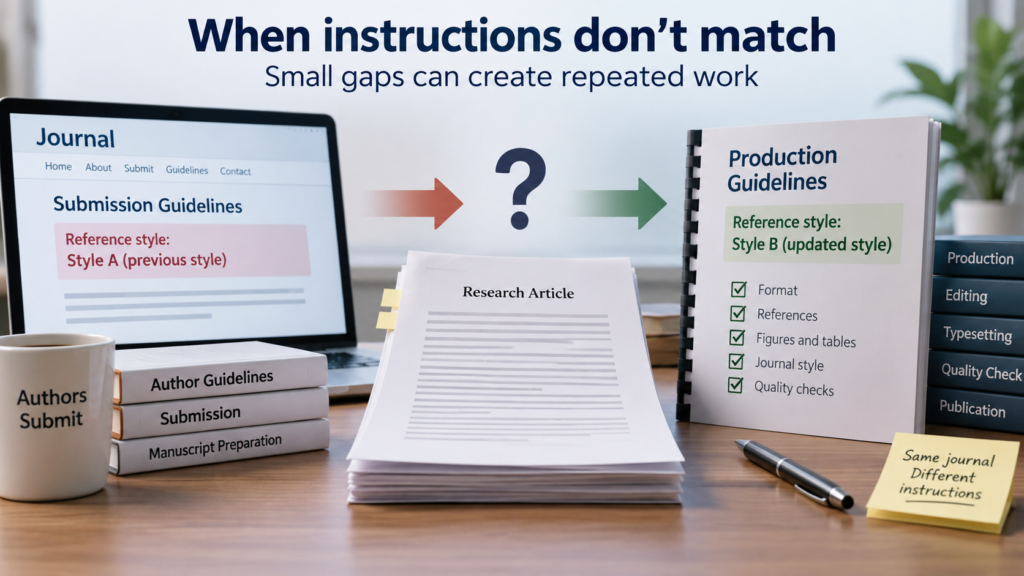
A journal changes its reference style after a discussion between the publishing editor and the journal editor.
The production editors are informed. The production guidelines are updated, and the production teams start following the new reference style.
However, the submission guidelines on the journal portal are not updated and continue to show the old reference style.
Authors preparing their manuscripts still follow the submission guidelines available on the journal portal. When an article reaches production, the references are in a style that the production team no longer follows.
Now, the production team has to contact the author and request an updated manuscript. The author may point out that the manuscript was prepared according to the journal’s submission guidelines.
Even if the author agrees to make the changes, both the author and the production team spend time resolving a problem that could have been avoided at its root.
The issue did not begin when the manuscript reached production. It began when the reference style was changed but the change was not carried through to every place where that instruction appeared.
An instruction is only useful if it is current
Updating an internal production guideline is not always enough.
When a journal requirement changes, the update may affect author guidelines, production instructions, checklists, templates, automated systems, or other documents used at different stages of the publishing workflow.
If one source continues to mention the old requirement, different people may follow different instructions while each believes they are following the correct process.
This creates unnecessary queries, corrections, rework, and delays. It can also create a poor author experience. An author should not be asked to correct something that was prepared according to instructions provided by the journal itself.
Old instructions can create another problem
A similar situation can occur within the production workflow.
Suppose a revised style guide is uploaded to the system used by production teams, but the previous version is not removed. Both documents remain available.
Which one should the production team follow?
People who received the communication about the change may know which version is current. Someone joining the journal later, covering for a colleague, or simply accessing the guidelines without that background may not.
The responsibility for an update therefore does not end with uploading the new document and informing the team. The person coordinating the change also needs to check that the earlier version has been removed or clearly marked as obsolete or “Do not use.”
Small gaps can create repeated waste
These may look like small administrative details: updating a webpage, replacing a file, removing an old document, or checking that everyone has access to the latest version.
However, the effect can multiply. One outdated instruction may affect many authors. One obsolete style guide may result in several articles being prepared incorrectly. Every instance can then generate emails, queries, corrections, additional checks, and frustration for people who have followed the information available to them.
This is why repeated errors should not always lead immediately to another reminder or training session. If different people keep making the same mistake, it is worth checking what instructions they are seeing and where those instructions come from.
Clear instructions need to be managed
Clear instructions are not only about writing a good style guide. They also need to be current, consistent, accessible, and aligned across the publishing workflow.
When a requirement changes, updating one document or informing one team is not enough. The change needs to reach every place where authors, production teams, or other stakeholders may look for guidance. Earlier instructions also need to be removed or clearly marked so that they cannot continue to influence the workflow.
A process should not depend on people remembering which instruction is current. The correct instruction should be the easiest one to find and follow.
Small gaps in managing instructions can create repeated work across the publishing process. Closing those gaps at the source can save time, reduce rework, and prevent avoidable frustration for both authors and production teams.
If you work in journal publishing and are interested in the systems, workflows, and everyday decisions that shape the publication process, you may also find my book Journal Publishing Behind the Scenes: Systems, KPIs, and the Illusion of Progress useful.