
By Divya Jyoti Munjal
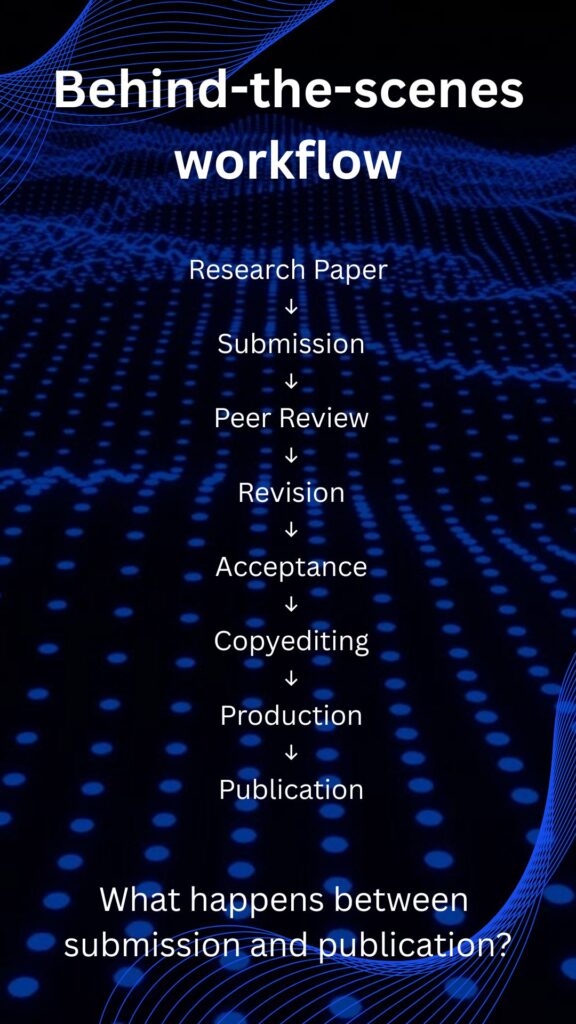
Recently, someone asked me a simple question: “What is Journal Publishing Behind the Scenes about?”
At first, I thought the answer would be straightforward. Then I realized that the question itself reflects something many people wonder about.
Most of us know what happens before a manuscript is submitted. Authors conduct research, analyze the results, write the paper, and submit it to a journal. We also know that the final outcome would be a published research article.
What remains largely invisible is everything that happens in between. That invisible journey is what my book explores.
Why does the publishing process feel like a black box?
For many authors, submitting a manuscript feels like handing it over to a black box. The manuscript disappears into the journal’s system, and weeks or even months later, an email arrives with a decision.
During that time, authors often wonder:
- Who is handling my manuscript?
- Why is it taking so long?
- What happens after acceptance?
- Why are there so many queries during production?
These are reasonable questions. However, without understanding how journal publishing works, the answers are not always obvious.
The journey from submission to publication
A research paper does not move directly from submission to publication.
After submission, the manuscript is checked to ensure it meets the journal’s basic requirements. It is then assessed by the handling editor, who decides whether it should proceed for peer review. If it does, independent reviewers evaluate the research, and the author may be asked to revise the manuscript before a final editorial decision is made.
Acceptance is not the end of the journey. It marks the beginning of another important phase. The manuscript enters production, where it is prepared for publication through processes such as copyediting, typesetting, proof review, corrections, and final publication.
Behind each of these stages are professionals working together to ensure that the published article is accurate, readable, consistent, and professionally presented.
Why understanding the process matters
Understanding the publishing workflow helps authors develop realistic expectations, communicate more effectively with journals, and appreciate the work carried out by editorial and production teams.
It also helps publishing professionals understand how their individual responsibilities contribute to the quality of the final publication.
When people understand not only what happens but also why it happens, the publishing journey becomes much clearer.
Why I wrote Journal Publishing Behind the Scenes
During my years in scholarly publishing, I noticed that many questions from authors, researchers, and even new publishing professionals were not about research itself. They were about the publishing process.
Many people understood their own responsibilities well but had limited visibility into what happened before or after their part of the workflow.
That observation inspired me to write Journal Publishing Behind the Scenes.
Rather than focusing on a single stage of publishing, I wanted to explain how the entire journey fits together, from submission to publication, and introduce the people, processes, and decisions that make scholarly publishing possible.
Final thoughts
Journal publishing is a collaborative effort involving editors, reviewers, production teams, and many other publishing professionals working towards a common goal: communicating research accurately and effectively.
Although much of this work happens behind the scenes, understanding it can make the publishing journey less confusing and far more meaningful.
If you have ever wondered what happens after a manuscript is submitted, or why journal publishing involves so many stages, I hope this article has answered some of those questions. If you would like to explore the journey in greater depth, Journal Publishing Behind the Scenes was written with exactly that purpose in mind.