

By Divya Jyoti Munjal
Receiving an acceptance email is one of the happiest moments in an author’s publishing journey. After months of writing, revising, responding to reviewers, and waiting for editorial decisions, acceptance feels like the finish line to authors.
I have observed during my years in journal production that many authors assume publication is simply a matter of waiting for the article to appear online. In reality, every accepted manuscript continues through a carefully managed production workflow before it reaches readers.
Although the research has been accepted, it still has to pass through several production stages before readers see the final published article. Much of this work happens behind the scenes, which is why many authors are unaware of the effort that follows acceptance.
Entering the production stage
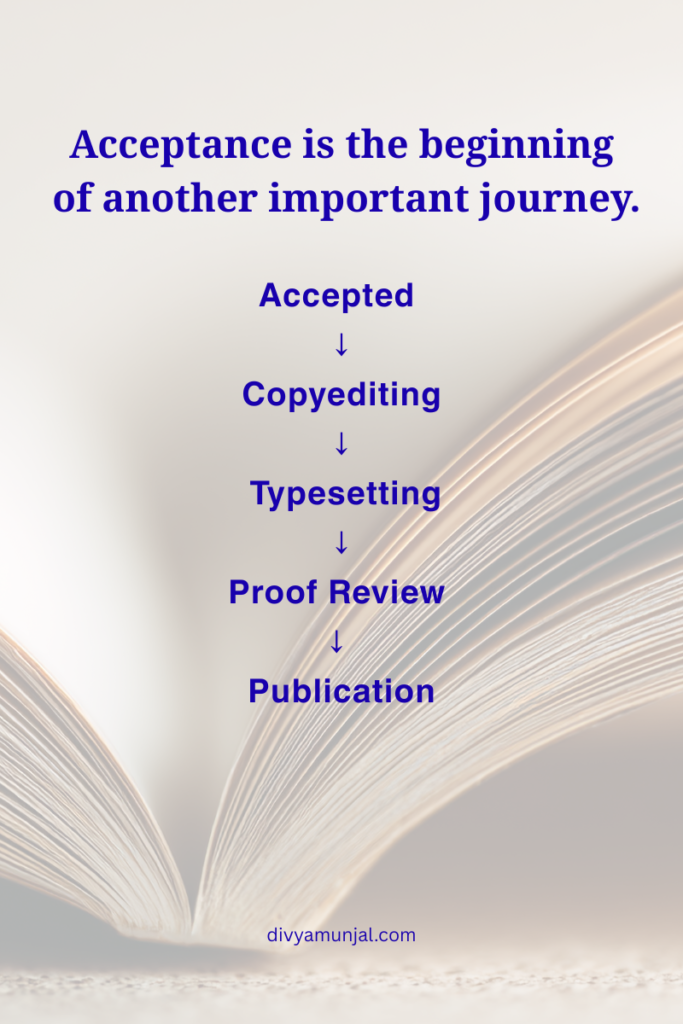
Once a manuscript is accepted, it moves from the editorial office to the production team. From this point onward, the focus shifts from evaluating the research to preparing it for publication.
Every journal follows its own workflow, but the production process typically includes several important stages.
Copyediting
At the copyediting stage, the manuscript is reviewed for grammar, punctuation, consistency, style, references, and formatting. The aim is to improve clarity while preserving the author’s intended meaning and voice. If the text is unclear or inconsistent, queries are raised to the author.
Typesetting
The edited manuscript is transformed into the journal’s publication layout. Figures, tables, equations, headings, references, and page design are arranged according to the journal’s style.
Author proof review
Authors are usually given an opportunity to review the typeset proofs. This stage is not intended for rewriting the manuscript but for identifying production errors, checking formatting, and confirming that the article accurately reflects the approved version.
Corrections
Any approved changes identified during proof review are incorporated into the manuscript. Depending on the journal’s workflow, these corrections may undergo further verification before moving forward.
Quality Checks
Before publication, the article passes through a series of quality checks. These may include verifying metadata, checking references, confirming figure quality, reviewing links, ensuring consistency across files, and validating publication-ready outputs.
The article gets ready for publication only after completion of these stages
Why authors rarely see this work
Unlike peer review, production often takes place quietly in the background. Authors may receive only occasional updates while numerous people continue working on the manuscript.
Production editors, copy editors, typesetters, quality specialists, and technology teams contribute to preparing the final version. Their work may not always be visible, but it plays an important role in ensuring that the published article is accurate, consistent, and professionally presented.
Acceptance is a milestone, not the end
Acceptance is certainly a moment worth celebrating. It represents the successful completion of peer review and editorial evaluation.
At the same time, it also marks the beginning of another collaborative process that transforms an accepted manuscript into a published research article.
Understanding what happens after acceptance helps us appreciate that journal publishing is not a single event, but a carefully managed process involving many people working toward one shared goal: bringing quality research to readers.
This is one of the many behind-the-scenes aspects of journal publishing explored in my book, Journal Publishing Behind the Scenes.