

By Divya Jyoti Munjal
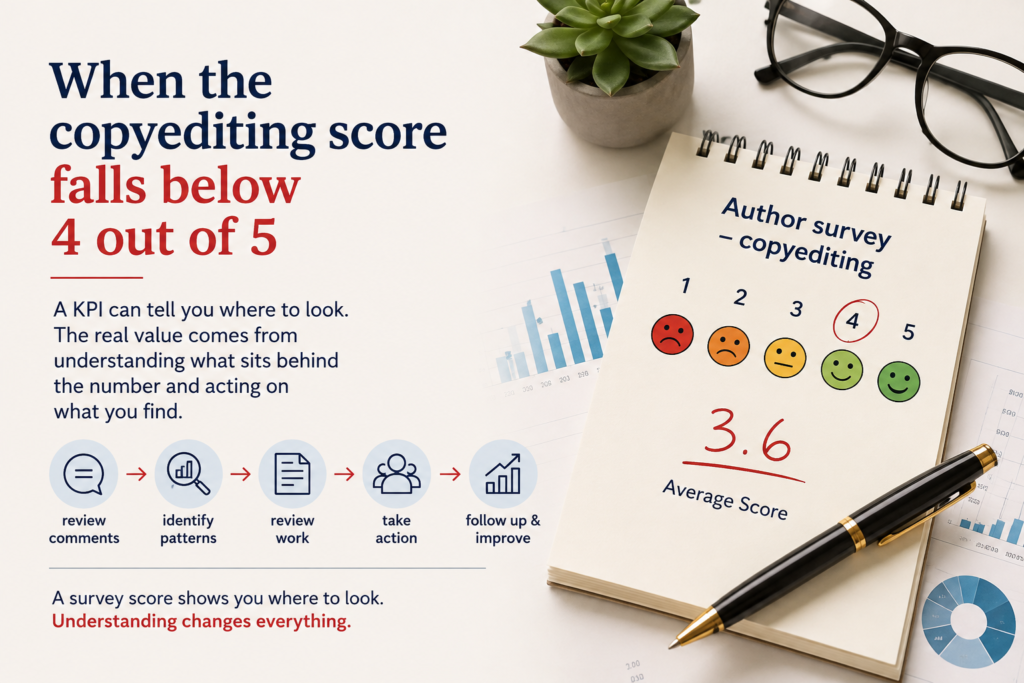
If an author survey score for copyediting is less than 4 out of 5, it should be taken seriously. However, a production editor or content manager cannot determine what went wrong based solely on the score.
Was there too much editing? Were mistakes overlooked? Were the author queries hard to understand? Was the intended meaning altered by an edit? Or was there some aspect of the production process that the author did not like?
Understanding the factors influencing the score is the first step before attempting to raise it.
Start with what authors are saying
Start with the remarks related to lower ratings. Put comparable issues in one group. Comments on excessive editing, overlooked mistakes, ambiguous queries, meaning changes, or uneven editing may be noticed.
Every low rating should not be seen as proof of a more serious issue. Look for trends over a fair amount of time. The same issue should be given more consideration if it is brought up by multiple contributors.
Next, break down the feedback. Is the pattern connected to a specific article type, workflow, vendor, editor, or journal? Instead of viewing the entire copyediting process as a problem, this helps focus the study.
Examine the real work
Examine a small sample of the pertinent manuscripts when you have found a trend.
Compare the original and changed files if the authors have complained about needless modifications. Examine the writing style if queries are the issue. If authors point out mistakes that were overlooked, find out if these are isolated instances or if the same problems show up in other publications.
This phase is important because, although a manuscript review aids in evaluating the editing work, an author survey records the author’s experience. Before you decide what to do, you need both.
Put the results into practice
Inform the appropriate editor, vendor, or production team with specific discoveries. Saying something like, “Our copyediting score is below 4. Please improve it,” is not really helpful.
Instead, discuss the findings of the review and get a consensus on a few targeted steps. These could include outlining the desired degree of editing, improving author queries, examining reoccurring mistakes, providing editors with examples, or keeping a closer eye on a vendor’s work for a while.
Make a brief note of the things that were found and the steps that were taken. Examine the feedback again after the next survey results are received to see if the same issues are still present.
Look past the score
Moving a score from 3.8 to 4.1 should not be the only goal.
The true goal is to comprehend the reasons behind authors’ experiences and what can be reasonably improved.
You can find out where to look by using a KPI. Understanding what is behind the numbers and taking action on what you discover is where the true value lies.
One of the topics I address in my book, Journal Publishing Behind the Scenes: Systems, KPIs, and the Illusion of Progress, is the connection between metrics, procedures, and the experiences that underlie those figures.
Found this useful? Join my email list for more publishing and editorial insights: Email list