

By Divya Jyoti Munjal
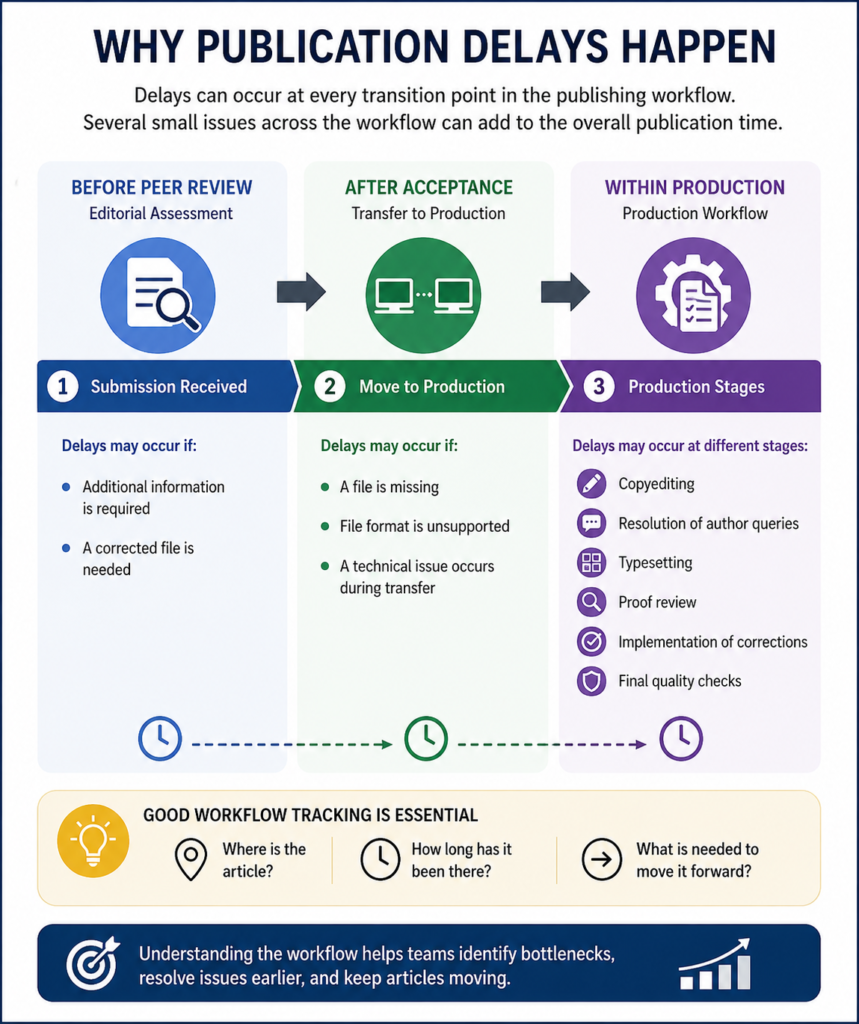
When a paper takes longer than expected to get published, it is easy to look for one major cause. However, it is not just one thing. Several small delays at different stages can add to the overall publication time.
To understand what is happening, it is not enough to track how long the entire process took. We also need to know where additional time was added.
Step 1: Before reviewers see it
When an author submits a paper, the journal usually carries out initial checks before it moves to editorial assessment and peer review. These checks are a normal part of the process, but additional time may be needed if something is missing or needs correction.
Common issues include:
- Missing files or figures
- Incomplete author or submission information
- Files that need to be corrected or uploaded in a different format
If the author needs to provide additional information or files, the paper may not be able to move forward immediately. As a result, the author may feel that peer review is taking a long time, although the paper is still completing the steps required before peer review can begin.
Step 2: From acceptance to production
Acceptance is an important milestone, but the paper still needs to move from the editorial system to the production workflow.
This transfer may happen through automated systems, manual actions, or a combination of both. Additional time may be needed if:
- A file is not supported by the production system.
- A required file does not transfer successfully.
- A technical issue interrupts the transfer.
This transition is another stage worth tracking, particularly when an accepted paper has not yet reached production.
Step 3: Inside production
Once the production team receives the paper, it moves through stages such as copyediting, resolution of author queries, typesetting, proof review, implementation of corrections, final quality checks, and online publication.
Additional time may be needed when:
- A query requires clarification from the author.
- Proof corrections take longer than expected.
- A figure or table needs attention.
- A final quality check identifies something that needs correction.
One issue may add only a small amount of time. Several such issues across the workflow, however, can have a much greater effect on the publication timeline.
Why knowing the stage matters
Knowing that a paper took six months to publish tells us the overall turnaround time. It does not tell us where additional time was spent.
Publishing teams therefore need visibility into where a paper is, how long it has been at that stage, and what is needed to move it forward.
When we can identify where time is being added, it becomes much easier to understand recurring bottlenecks and look for practical ways to improve the workflow.
For a deeper look at journal workflows, production challenges, and the systems behind publication, you can explore my book, Journal Publishing Behind the Scenes: Systems, KPIs, and the Illusion of Progress.
Stay connected with Publishing & Editorial Insights. Join the Email List.
Oh yes. I believe in working smartly. I still make mistakes. So, it’s not about mistakes. It is about learning from them.