

By Divya Jyoti Munjal
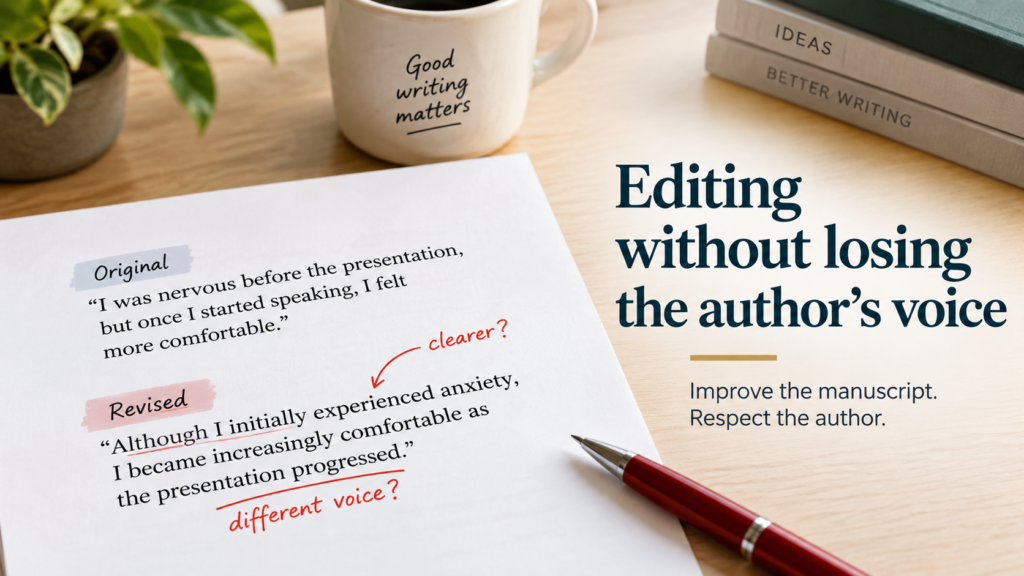
A copy editor reads this sentence:
“I was nervous before the presentation, but once I started speaking, I felt more comfortable.”
There is nothing grammatically wrong with it. The meaning is clear, and the language sounds natural.
However, the copy editor may be tempted to make it sound more polished:
“Although I initially experienced anxiety, I became increasingly comfortable as the presentation progressed.”
The revised sentence is also grammatically correct and may sound more formal, but is it better? Not necessarily.
The first sentence sounds like someone naturally describing an experience. The second sounds more formal and distant. In trying to improve a sentence that was already clear, the copy editor has changed something important: the author’s voice.
Copyediting is not about rewriting every sentence that could be written differently. It is about knowing what needs to be changed and what should be left alone.
What makes a sentence sound like the author?
An author’s voice develops through choices that appear throughout the manuscript. Word choice, sentence structure, rhythm, tone, and level of formality can all contribute to it.
One author may write “I was nervous,” whereas another may naturally write “I felt anxious.” Some authors prefer short, direct sentences, whereas others use longer sentences to develop an idea. These differences do not necessarily need correction.
This is why a copy editor needs to understand the author’s writing before making stylistic changes.
The question is not always “Can this sentence be rewritten?” Sometimes, it is “Does this sentence need to be rewritten?”
When does an edit become a preference?
Here is another example:
“The results were surprising, and we wanted to understand why.”
A copy editor might prefer:
“The results were unexpected, prompting us to investigate the reasons.”
The second sentence sounds more formal, but that alone is not a reason to change the original. If the first sentence is clear, appropriate for the manuscript, and consistent with the author’s style, the revision may reflect the copy editor’s preference rather than an editorial need.
Before making a stylistic change, it is important to know why the change is needed. Does it improve clarity, correct an error, remove ambiguity, or bring the text in line with the required style? Or does it simply replace the author’s choice with the copy editor’s choice?
When is a change necessary?
Preserving the author’s voice does not mean leaving every sentence untouched.
“When Maya spoke to Priya about her revised proposal, she was concerned about the deadline.”
Who was concerned about the deadline: Maya or Priya?
Here, the meaning is unclear. If the context establishes who was concerned, the sentence can be revised. If it does not, the copy editor should query rather than assume.
A change may also be necessary when a sentence contains a grammatical error, does not follow the required style, uses terminology inconsistently, or is difficult for the intended reader to understand.
In each case, there is a reason for the editing decision.
Look for patterns across the manuscript
A sentence should not always be read in isolation. An expression that looks unusual on page 2 may appear throughout the manuscript. Short sentences may be part of the author’s natural rhythm. A conversational phrase may be a deliberate part of the author’s style rather than something that needs correction.
Recognizing these patterns helps the copy editor distinguish between the author’s voice and something that genuinely needs attention.
The copy editor should not become visible
A heavily edited manuscript may be grammatically polished and perfectly consistent, yet it may no longer sound like the person who wrote it.
Good copyediting improves the manuscript without making the author sound like the copy editor. Sometimes that requires rewriting a sentence or raising a query. At other times, the best editing decision is to leave the sentence exactly as the author wrote it.
If you are an aspiring or early-career copy editor looking to develop the judgment behind editing decisions, you may also find my book Building the Copy Editor’s Mindset: Theory and Rules for Early-Career Editors useful.